ARTIST STATEMENT
I was born in Moscow to a Russian mother and an Armenian father, both born and raised in Baku, Azerbaijan, then part of the USSR. Their own complicated relationship to identity left its mark on me in ways I'm still working through. I always looked visibly Armenian in places that didn't accept "otherness." My body was never a neutral fact either. It changed constantly through puberty, and it represented a lot of things to a lot of people. To my mother, shaped by her own war with thinness, it was a reminder that I was never going to be the delicate, graceful ideal of femininity and acceptance at the time. To boys at school, my developing body was an invitation for sexual harassment and physical violence. To the other girls, I was different, and therefore not part of the pack, and therefore a reason to make cruel public comments at my expense, to heal their own egos.
Immigrating to the US in 1999, at sixteen, didn't undo any of the earlier trauma, but it did give me a break from the racial bullying. What replaced it arrived fast: Y2K's obsession with low-rise jeans, visible hip bones, and the tabloid-fueled "size zero" ideal swept into my high school years, and it was a challenge to try to be thin when the very nature of my ancestry screamed of curves.
Understanding all this didn't happen overnight. While studying graphic design, I was exposed to figure drawing courses, and they left a mark. I'd been interested in art since I was young, ever since my mother shared her love of Impressionists like Toulouse-Lautrec and Matisse, taking me to the Pushkin Museum in Moscow. When I finally recognized myself as an artist, a journey of its own, it felt like second nature that I would paint what I knew: a female form, my form.
In my art practice, I found a place where my body is not a territory for others to claim, but is all mine to tell stories with, to show in whatever light I want, to express all that my body does for me and against me: endometriosis, adenomyosis, perimenopause. What memory it holds, of physical violence, of sexual trauma. It is mine to rejoice in, too, to archive spontaneous joy and full acceptance and love.
My process moves between painting, photography, and mixed media. Some figures are built from memory, imagination, and reference. Others come directly from my own life, photographed exactly as a moment gives it to me, sometimes a landscape, sometimes pain itself, undirected and unedited. The women who appear across my work carry the weight of bodies that have been judged, watched, corrected, or simply endured. Still, none of them ask to be fixed. They hold their own contradictions, unresolved, and keep existing on their own terms.
Immigrating to the US in 1999, at sixteen, didn't undo any of the earlier trauma, but it did give me a break from the racial bullying. What replaced it arrived fast: Y2K's obsession with low-rise jeans, visible hip bones, and the tabloid-fueled "size zero" ideal swept into my high school years, and it was a challenge to try to be thin when the very nature of my ancestry screamed of curves.
Understanding all this didn't happen overnight. While studying graphic design, I was exposed to figure drawing courses, and they left a mark. I'd been interested in art since I was young, ever since my mother shared her love of Impressionists like Toulouse-Lautrec and Matisse, taking me to the Pushkin Museum in Moscow. When I finally recognized myself as an artist, a journey of its own, it felt like second nature that I would paint what I knew: a female form, my form.
In my art practice, I found a place where my body is not a territory for others to claim, but is all mine to tell stories with, to show in whatever light I want, to express all that my body does for me and against me: endometriosis, adenomyosis, perimenopause. What memory it holds, of physical violence, of sexual trauma. It is mine to rejoice in, too, to archive spontaneous joy and full acceptance and love.
My process moves between painting, photography, and mixed media. Some figures are built from memory, imagination, and reference. Others come directly from my own life, photographed exactly as a moment gives it to me, sometimes a landscape, sometimes pain itself, undirected and unedited. The women who appear across my work carry the weight of bodies that have been judged, watched, corrected, or simply endured. Still, none of them ask to be fixed. They hold their own contradictions, unresolved, and keep existing on their own terms.
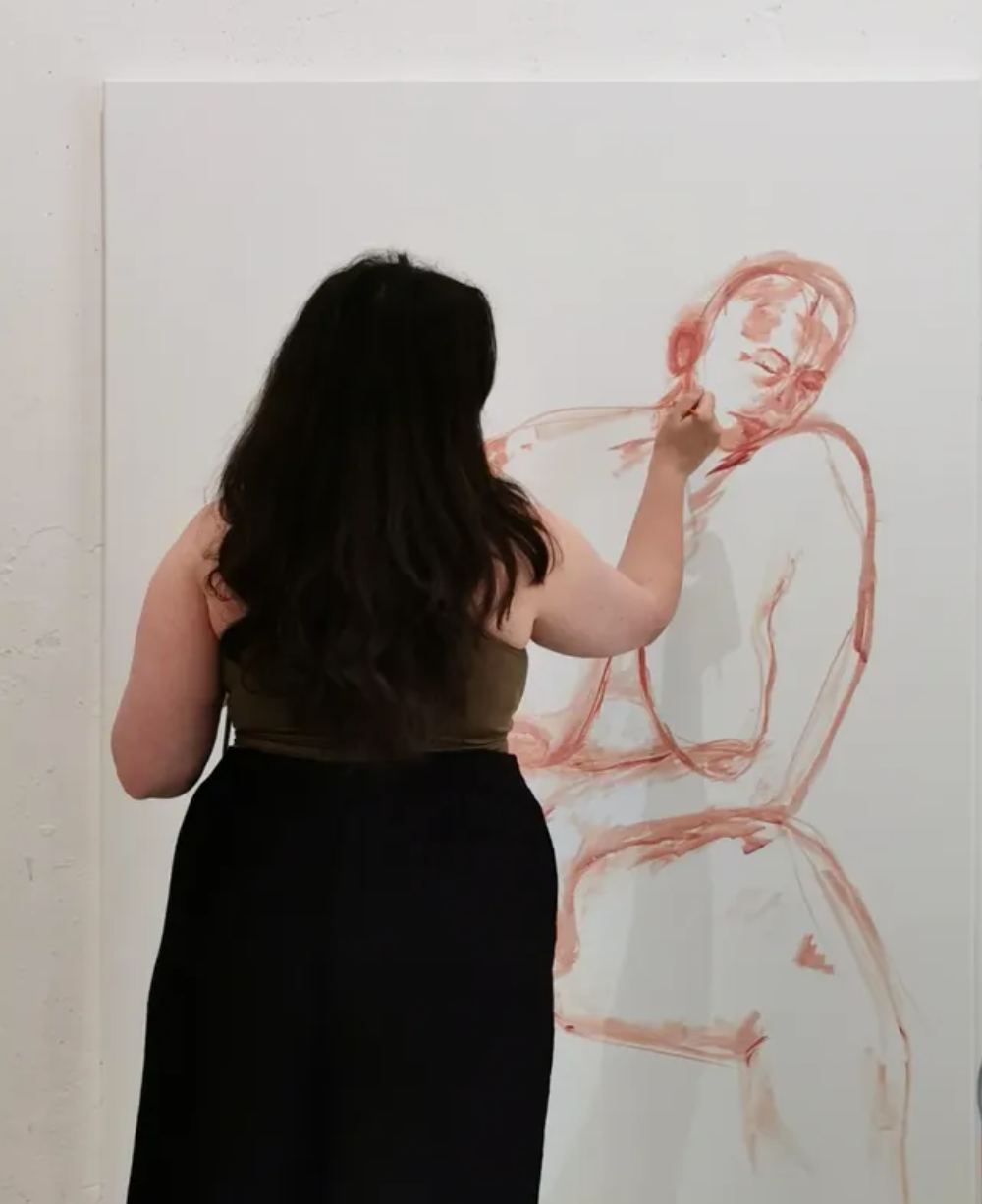
LARA SHIRINYANTS (b. 1983, Moscow) is a Russian-Armenian visual artist currently living and working in Berlin.
Her figurative paintings and photographic work navigate complex themes such as body image, identity, and personal history, often rooted in her own experiences of childhood trauma. Through her work, Shirinyants invites viewers into intimate, emotionally charged spaces where the boundaries between personal and universal narratives blur, prompting reflections on memory, reckoning, and self-perception.
Influenced by her multicultural background and evolving sense of belonging, Shirinyants' art is characterized by its introspective depth and its exploration of human vulnerability. Her distinct approach blends emotional resonance with a nuanced study of form and color, capturing the tension between the visible and the unseen. By addressing deeply personal themes, she opens pathways for broader conversations around identity and the ways we inhabit our own stories.